


This issue was hard to write. It’s a bit of a confession...
Two weeks ago, I was sitting in the Boston airport with my partner Bill.
We’d been at an event all week.
And during event breaks and in the evenings we were going back and forth with a team member who we’d asked to take the lead on an underperforming marketing channel.
For three weeks, we’d been asking for his assessment and plan for turning it around.
The night before, we’d received an AI report from this person.
It was 11+ pages long.
Bill and I read it that night.
It had more holes than Swiss cheese.
Bad assumptions, incomplete thinking, and what seemed to me to be the wrong conclusions.
We gave feedback and asked for an update before our afternoon flights the next day.
So we’re sitting there in Boston-Logan Airport when the update arrived.
Another dozen or so AI pages to wade through.
Better, but the action plan made no sense to me.
Admittedly, I was pissed (which doesn’t happen often).
“We’d waited three weeks for this?”
We all knew this was a top priority in the business.
Bill left for his flight and I took 30 minutes before mine boarded to take all the data and start my own analysis with the help of AI.
I boarded, we took off, and I jumped on the WiFi (thank you Delta).
By the time we’d landed I’d done three rounds of analysis and had some meaningful and actionable conclusions.
Three weeks of asking. About two hours of doing.
I realized in that process that the bar just got raised for everyone on our team...and everyone in every company.
It’s easy to get impressive-looking analysis now.
But looks don’t move the needle.
We came to the realization that the team member no longer fit the capabilities we needed.
I hate firing people. With. A. Passion.
I view it as a failure.
First, my failure.
Because I failed in fit, training, expectations, accountability, or leadership.
And, yes, usually the team member had failures to own, too.
But I can’t control what other people do.
All the learnings are inside the actions I can control.
So, I’ve reflected on it over the last two weeks.
My conclusion...
This was our first AI casualty.
But not in the way you’d think.
AI didn’t replace this person’s job. It can’t.
It raised the bar for the person in the role. And those two hours on the plane made the gap painfully clear.
I’m not happy about or proud of any of this. But I am committed to understanding it and learning.
And learn I did...
Out of it, I discovered a framework for hiring, evaluating, elevating, and leading your team in The Age of AI.
What I’m calling The S.C.A.L.E. Loop...
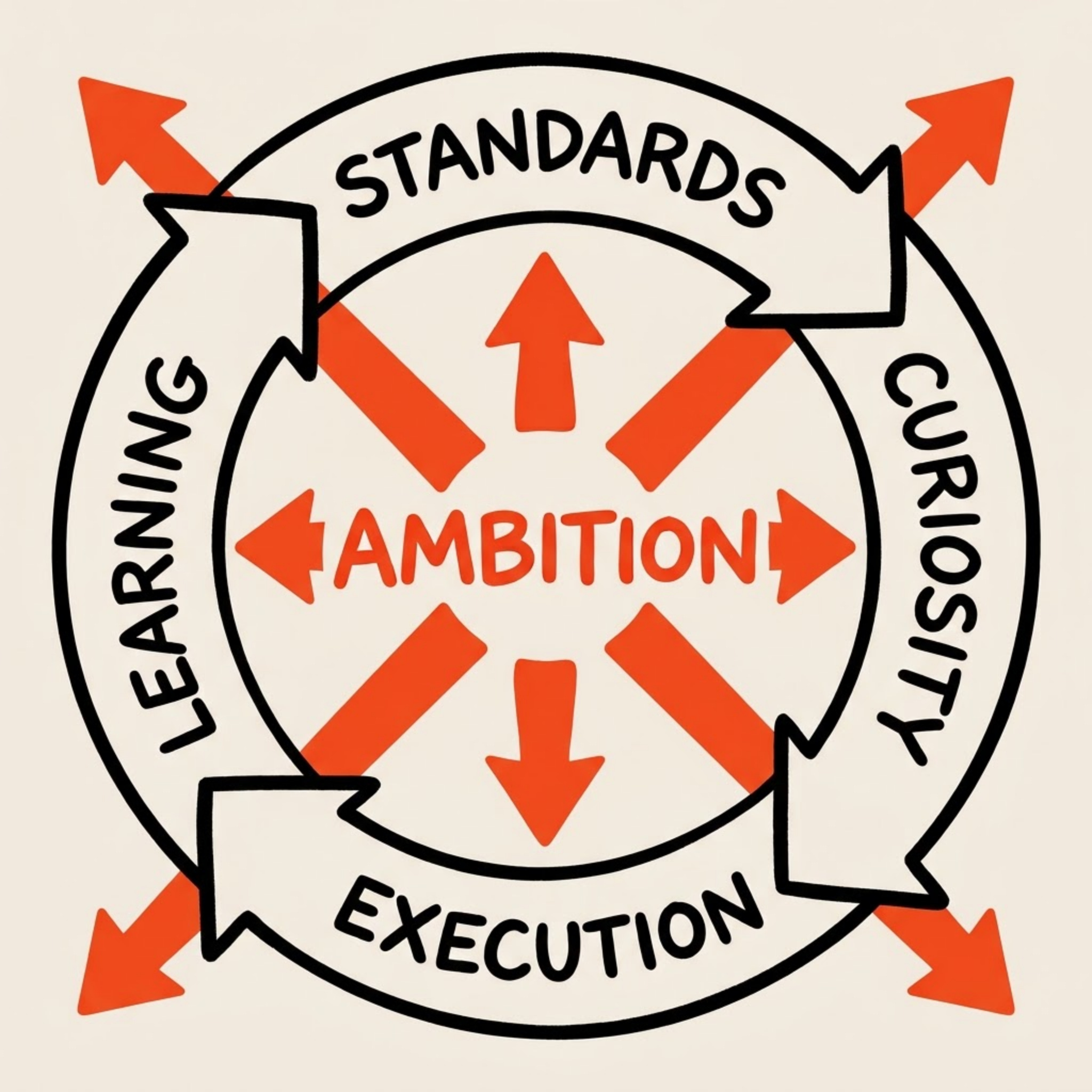
The loop runs in this order: STANDARDS -> CURIOSITY -> EXECUTION -> LEARNING and back around, over and over.
AMBITION sits in the middle. It’s the byproduct you get when you run the loop >> expanding ambition.
S -> STANDARDS
Standards are knowing what “great” looks like AND defining it clearly enough to hand it to someone on the team (human or AI) so they can evaluate an output.
Every leader owes this to the team, and every team member must own sussing out the standard if it’s not been given.
Work can’t start until the standard is set. Both leader and team member must independently take ownership for establishing the standard before the work begins.
I’ve noticed that this discipline of standard-setting is harder than ever now that AI is on the scene. Because it’s easier than ever to get going and to get an output.
Ease is making us all a little sloppy.
C -> CURIOSITY
Curiosity runs in two directions at the same time...
First, it must run backward at the answer. AI creates something, and the team member must have skeptical curiosity about the output.
Where are the holes?
What are the assumptions? Are they valid?
Was the input data complete? Did the AI understand its meaning?
Do the conclusions make sense?
Are the recommended actions logical?
Second, curiosity must run forward, toward the frontier. Being super-curious about what’s possible now that wasn’t possible last month, because AI moved...
Where can time be compressed?
What can we do with the time we gain?
What questions did we skip because the effort was too great before?
Which assumptions that we hold today no longer make sense?
What was resource-constrained before that we can tackle now?
Skepticism towards output and openness towards what’s newly possible are the same mental muscle... asking great questions and being comfortable exploring down the rabbit hole until you get to truth and real possibility.
E -> EXECUTION
Decisive tests, run fast is the order of the day. Experiment and iterate...in hours and days, not weeks or months. The bias in every person on the team should be towards finding out over analyzing further. That’s executing.
AI has collapsed the cost of executing on an experiment in almost every part of your business. Most teams haven’t adapted to the new pace.
L -> LEARNING
Learning is what you get from Execution.
Every test you run produces:
A result
An explanation
Most companies take the result and throw away the explanation.
The campaign worked! The offer bombed!
Six months later, no one can remember why.
A year later, you hit the same problem again and maybe pull those old lessons forward (if you’re lucky).
Now, AI can capture, organize, and recall those learnings...ready when you need them.
Not just the output, the logic and reasoning you used.
And it survives changes within the team and the frailty of human memory.
Each new experiment now becomes the foundation for the next.
You get smarter as a company... daily.
In a documented and concrete way.
Practically, this is simple...
Write up what you did, what happened, what you now believe as a result, and what you decided to do.
And it’s easy... AI becomes the documenter, librarian, and retriever. Humans control the judgment of what learnings matter.
A -> AMBITION
Ambition sits in the middle of the framework, and it’s the result you get when you run the loop with a HUMAN+AI team.
You want the humans on your team to live expanding ambition...
The more they run the loop, the better they get at setting standards and asking great questions; the more capability they gain with AI; the more they learn from execution; the more possibilities they see...
Their ambition expands daily... and that drives the business forward.
This framework didn’t just emerge from the firing experience.
At the same time, I was watching our head of ops, Agos Lupi, run this loop before I had words for it.
Agos has a psychology degree...she’ll tell you she’s not technical.
But when she took over ops, we had some challenges.
We’d invested $30k in a custom database system to run our book production process. It helped, but the firm we hired really only built 60% of the solution we needed.
I showed Agos how to set up Claude Code, and she started playing with it.
After looking at what it would cost to hire outside help to get the custom database to 100%, I wondered what we could do on our own with AI.
When I shared that thought with Agos, she ran with it.
She set the standard for what she wanted from the app... the way the team would use it; how it would free them from admin to be more personal and proactive with clients.
She got curious... what can it do? Can I just talk to it and get anything good?
Then she executed...
And in a week had a working app to run our production.
What we now call BookFlow.
This week, she moved the entire team onto it. It’s now our single source of truth.
And she’s running the loop...
Meeting with team members, learning what’s working, what’s not, what would eliminate routine and time-consuming work...
And those learnings go back into the standard... she pokes and prods to validate them, executes another iteration cycle, and on and on.
As she’s done that, I’ve watched her ambition around the project expand...daily.
One day she pinged me to show me something she’d developed...
We jumped on Zoom, and she revealed a new, beautifully designed, client-facing version. We went from having a backstage management tool to a tool to clearly communicate to every client where their project stands and what (if anything) we need from them now.
We’ll launch it in a few weeks. And it solves the #1 challenge we hear from clients...that they’re overwhelmed.
On the side, she’s built and launched (and got some paying customers for) a personal finance app specifically for young adults in Argentina, her home country.
That’s expanding ambition... and the loop applied.
That’s what you’re looking for, and that’s what you want to be coaching and leading your team towards.
The people who do it are about to rocket past those who don’t.
I see my job as a leader, now, to get as many people running the loop as possible.
Because this is how talent gets judged going forward. Output is no longer the metric because output is now cheap. The new metric is how well they question, how fast they find out, and how big their ambition grows.
What I got wrong for years...
I can look at a document and in four seconds know it missed the standard. I’ll bet you can, too. We earned that over years and decades.
And that means the standard has been in my head the whole time. Yet, more times than I want to admit, I’ve never written it down, or even articulated it.
Because learning the loop and applying it to real work is so important, I built an AI skill to walk my team through the SCALE Loop.
And, I’m giving it away to subscribers to my Substack.
Subscribe, then refresh the page, and you’ll see the download link here.
It works in Claude, ChatGPT, or any AI tool you already use.
It will ask 4 questions:
What does “good” look like for this work?
What assumptions are you using and what would prove them wrong?
What’s the smallest test you can run this week?
What do you expect to happen?
It’ll write a 1-page brief based on your answers.
When the work is done, give it that 1-pager and it will interview you to capture your learning.
Give it to your team and let them run it.