


So much of what happens in business is a waste of time...
I’m always amazed at the ability of chaos and entropy to take over.
It’s like cobwebs collecting on the ceiling...
A lot of entrepreneurs I know dismiss it...
As if putting things back in order distracts from making money.
I have a different view.
The stuff that accumulates in a business will eventually choke it to death.
Little things...
Like not following that naming convention for the files that everyone agreed on.
Or the contracts that have been modified and tweaked and tailored so much that you can’t remember what version is the “master.”
I’ve seen this inside so many companies that I know it’s the normal state.
You’ve got it somewhere...
That “MASTER-final-FINAL.docx”
As if capitalizing that 2nd “FINAL” would mean anything a week from now.
So why am I ranting on business cruft?
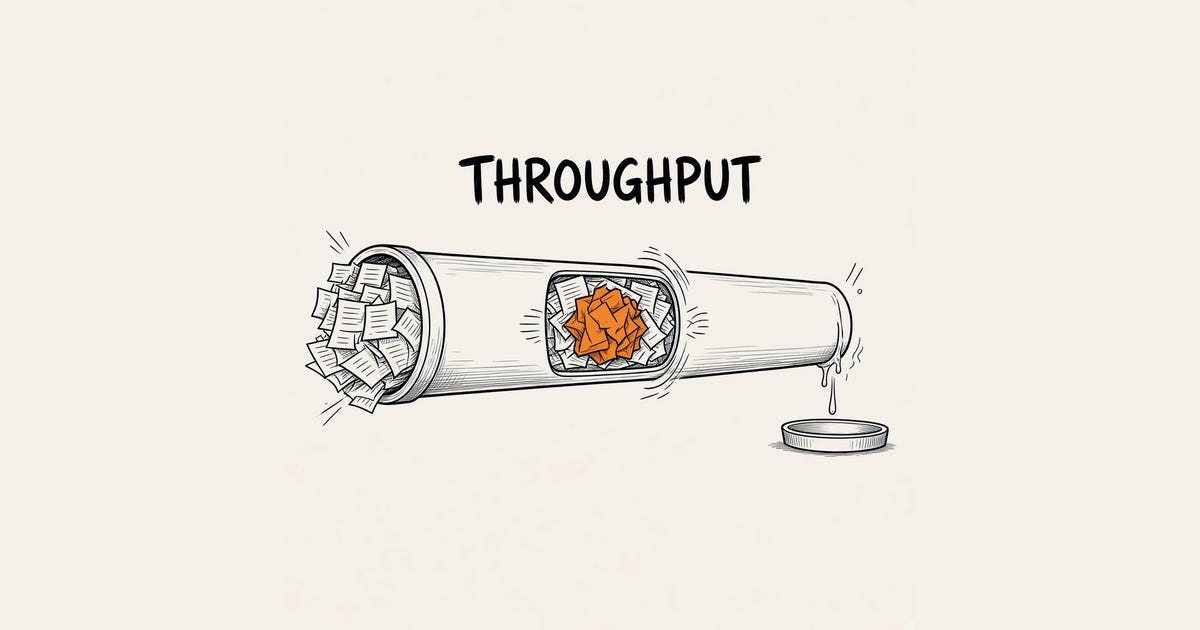
Because it’s the enemy of throughput.
And throughput is one of the most important (and under-appreciated) measures in business.
When I think on all of my years in business, two things are true...
The times I felt great, throughput was cranking.
And the times business felt crushing, throughput crawled.
The thing being pushed through was different, but the experience was a result of its throughput in the system...
Sometimes it was throughput of:
Capital
Deal flow
Production
Learning
Over the years, I’ve become acutely aware of changes in the business’s throughput.
In the past, you might see it, but it was often hard to fix.
It feels like trying to fix the wheels on the car while you’re driving 85 miles an hour down Interstate 95.
AI is changing that...
This week we attacked and unblocked three bottlenecks.
And I’ve extracted three new principles for solving throughput with AI...
Principle #1: (Re)Define the Workflow
Throughput problems are almost always a workflow issue.
You have to rethink it.
I love Elon’s 5-step algorithm for this...
Question every requirement. Trace every constraint to a specific named individual, not a department, and challenge its necessity to “make requirements less dumb.”
Delete any part or process you can: Ruthlessly remove unnecessary steps; if you do not end up adding back at least 10% of what you delete, you haven’t cut enough.
Simplify and optimize: Only simplify or optimize what remains after deletion, as optimizing a non-existent part is a common error.
Accelerate cycle time: Speed up the remaining processes only after the first three steps are complete.
Automate: Apply automation last, ensuring you are not automating inefficient or unnecessary workflows.
Most people want to start with #5 and automate what they’re already doing.
The normal course of business is additive.
And you end up with more... and more... and more...
Chaos and entropy!
My go-to move is to start with a blank canvas and build a picture of the workflow (just a flowchart).
Start from the blank page and ask:
“If none of this process existed, what would we build today?”
In the past, I’d make changes to a workflow, not start over.
AI is a big enough disruptor that if you’re not starting over, you’re probably not thinking big enough.
Principle #2: Appoint a Librarian
Clean, organized data is lubrication for throughput.
The friction factor is lowered.
Everything moves more easily.
This is one of the most boring things you could ever think to do...
But AI can both clean up your data and be the “librarian” that keeps it clean.
We’ve had a bottleneck in editing audiobooks for clients.
With the help of a redesigned workflow, we took a 4-week backlog and eliminated it in 48 hours.
But a major obstacle was how the recordings were organized in our virtual recording studio system.
In one of those moments that’ll make you turn 5 shades of red...
I discovered that the system’s auto-naming and filing system mislabeled recordings with the wrong client name.
Hard to find Bob’s recording when it’s filed as Stacy’s recording.
Was anything lost? No.
Was it a showstopper? No.
Did a client ever know it happened? No.
Did it create friction in the system? Absolutely!
In the past, keeping the data clean... especially unstructured data was almost impossible (trust me, I’ve tried).
Now, it’s a recurring AI scan/fix routine.
Everything’s clean every day.
Now, you might be thinking, “Steve, you’re really anal retentive; is it really THAT big a deal?”
I timed it.
Every time the team tried to find a recording in the system, they spent 10 to 40 minutes finding it!
Do the payroll math...
Times 20+ recording files per client...
Times 120-150 clients a year.
One stupid little thing starts to cost real money.
Now we have two things:
A written folder and file naming convention.
An AI librarian dedicated to keeping it organized.
Problem solved. Permanently.
Principle #3: Work in Primitives
Switching cost is one of the biggest throughput thieves.
Having information here and there across systems means your team jumps from tool to tool to get anything done.
More and more, we’re breaking the business down to “primitives.”
I believe there are just a handful of business primitives:
Documents
Messages
State
(I get it... this is a little theoretical, but stick with me.)
Thinking and working in primitives frees you to fully reimagine how you get work done.
Here’s how we’re approaching it...
Documents are docs, spreadsheets, and slide decks. That’s it. That’s all you need.
We’re building workflows around basic documents for all work in progress.
AI is really good at working with docs, spreadsheets, and slide decks.
I don’t accept anything from AI in chat. I want a doc that I can review on my time, without endlessly scrolling through a chat thread.
Six months ago, most people doing leading-edge work with AI said to work in a folder of text files.
Sure, that’s doable, but the experience is terrible.
And it’s horribly inefficient because there’s no “messaging”.
Messaging is any message you send about work. Might be email, Slack, or comments in a document.
One of the reasons we’ve seen such a big boost in productivity in the last two months is our move from text files to shared Google Docs.
In a Google Doc, anyone on the team (our people and our bots) can create work, put it in a doc for review, and we can review it.
We just leave comments in the doc. Humans and bots can read the comments. Those messages keep work moving, without needing any sophisticated system.
We’ve increased throughput on decisions, reviews, and approvals (the most common chokepoints for work) by 50%+.
We’re working to limit messaging to email (external), Slack (internal), and doc comments.
State is where each unit of work sits, and what’s next.
We used to handle state in tools like Asana, Notion, or Basecamp.
Now we have our internally developed production app, BookFlow, for the big work.
For everything else, we’re just using folders...
A typical small project might have a set of folders like this:
00-intake
10-on-deck
20-in-progress
30-ready-for-review
40-needs-revision
50-approved
60-complete
99-archive
Simple. Clear. No special software.
Just the primitives.
When you reduce the work to primitives, you unlock something important...
Flexibility.
In all of those fancy work management systems, you have to adapt your work to how they work.
With primitives, every option is on the table.
Any workflow is possible.
Friction is eliminated (not to mention expense).
I know this has been a deep trip down the rabbit hole.
Because of AI…
I’m thinking more about how we work than at any point in the last 35 years.
And I believe part of the value in the principles I’ve outlined is that they force you to simplify your thinking.
In times of rapid change, complexity is the enemy.
-Steve “go primitive” Gordon
P.S. When you’re ready, we can help you in three ways…
1. Turn you into a bestselling author in 90 days >> We’ll write, publish, and promote your book…100% your ideas + our proven process. Click here to learn more.
2. Be everywhere your prospects look >> Our Be Everywhere Now™ program takes one 90-minute interview with you and turns it into client-getting content on all the places your clients are paying attention. Book a call with me.
3. Make clients an offer so good they’d feel foolish saying no… Our Sales Accelerator™ program gives you a unique Irresistible Offer and a high-converting sales process. Talk to the team to learn more.