


Today, I’m going to do something I rarely do...
I’m going to take you behind the scenes on how we’re changing the business because of (and with) AI.
I don’t know about you, but I’m burned out on watching YouTube demonstrations that stop short of the good stuff...
And the product announcements from the AI companies that sound revolutionary, but your team is still using AI as a glorified secretary.
You’re not alone in feeling that:
58% of small businesses say they use AI.
But, 64% of users say they use it primarily for personal productivity.
41% say they’re unclear how or why AI is relevant to their role.
Just 6% of small business AI users are using it to automate workflows.
And only 6% of businesses report AI causing a 5% or greater impact on the bottom line.
So...we’re using and paying for “intelligence” and getting nowhere.
Yes, some individuals on the team might be more productive, but you and I as owners want to see more dollars on the bottom line.
Otherwise, what’s the point?
So, today, I’m going to show you what we’re doing differently...
How it’s changed our thinking on our work...
How it’s changing the structure of the business...
How it’s going to shift our hiring...
And how we’re beginning to drop dollars to the bottom line...
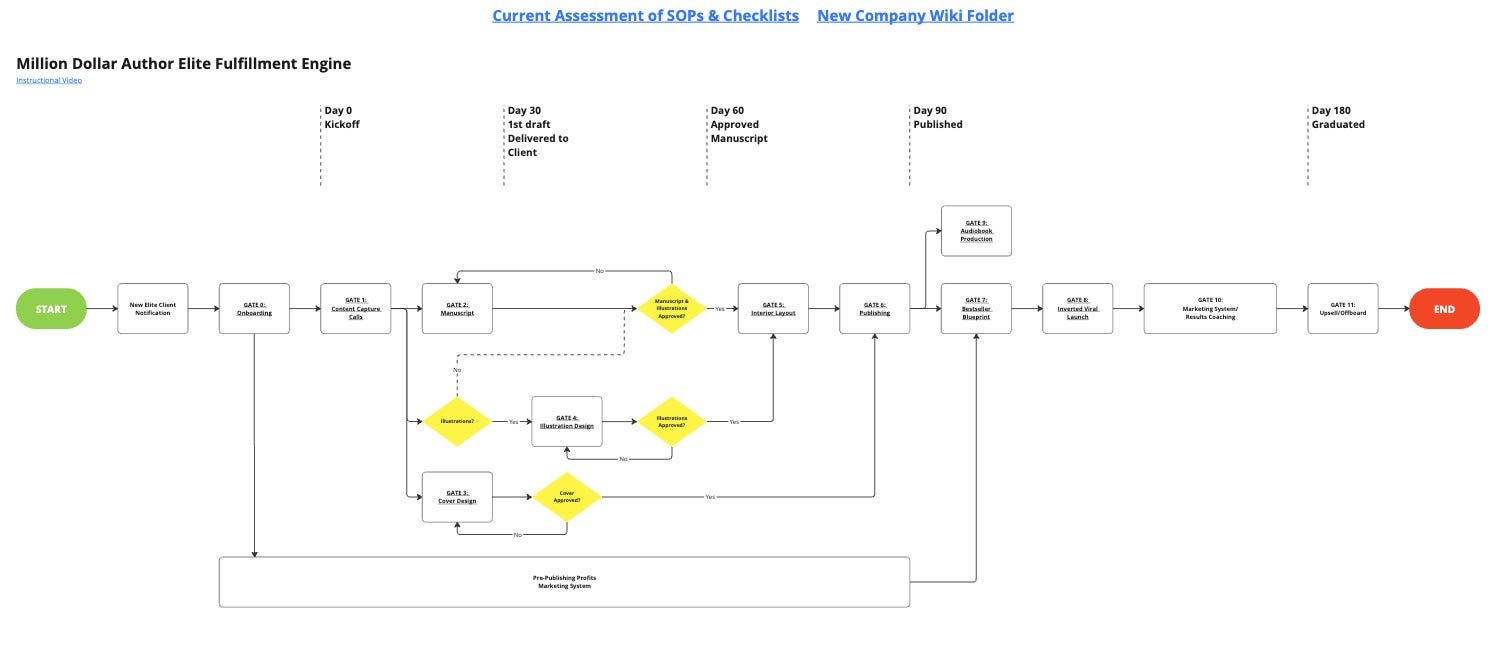
The 90-day book creation process we run at Million Dollar Author takes ideas from a client’s head and produces a bestselling book in 90 days.
If you’ve ever tried to write a book, you know that’s a heavy lift.
There are 102 discrete steps in the process. And each one has a definition of done and a 3-10-step checklist.
Part of the process must run in parallel to meet the 90-day timeline and other parts simply cannot run in parallel.
Here’s our master process map:
To make things more complex, we usually have 50-75 projects in-flight on any given day.
There are four ways projects can get stalled...
#1 Communication: I call this “squeaky wheel crashes the car.”
In most businesses, the loudest client gets the attention.
And the loudest client usually isn’t the most important client.
It’s human nature for your team to focus on the person that’s blowing up their inbox or acting unhappy.
You want them to be responsive to client needs.
And you need them focused on the right priorities.
When you get over 20 or 30 clients, it’s easy for the team to get sucked into firefighting the loudest and forgetting about the quiet clients.
In the past, we added some automations and manual manager checks to keep things from slipping.
#2 “Hide and Seek”: This one drives me up a wall. It sounds like this…
“Did you get the doc I sent?” “No, where is it?”
Then the game is on… let’s go find the doc, or the message, or the spreadsheet.
We have seven major systems that hold communication, project status, and work product…
HelpScout (client communication)
Slack (internal communication)
Voxer (leadership team comms)
Airtable (project state)
Google Drive (work product)
Notion (one-off projects)
CRM (texts from clients come here)
I’m embarrassed as I read that list. And I know from talking to peers that we’re not alone.
Almost every company has this kind of software sprawl.
We’re working on it… I think there’s a 12-step program ;-)
Over the last year, it’s gotten worse with AI. Now I’m hearing…
“Oh, it’s in Cowork on my laptop…let me send it to you.”
“I did that in Notion AI. Here’s the link.”
And my favorite…
“I got your Claude share link, but they never open for me. Can you send me a PDF?”
It’s only a slight upgrade from the sneaker net we had in my first business… IN 1995!
#3 Bottlenecks: If you’re doing any volume of work, there’s always some part of the process that’s backed up.
Right now, for us it’s audiobook engineering (editing and making a client sound great on Audible).
We’re running a 3-week backlog and working overtime to clear it.
You’re probably thinking of your own bottleneck as you read this.
Bottlenecks stress me out.
Because the solutions are usually never immediate. You have to work through it.
And, while you’re working through it, clients can, rightly, get a little frustrated.
That’s one of the reasons I try to have grace and patience sitting in barely moving the Chick-fil-A drive-thru at 5 pm on a Friday. Every business has bottlenecks… and no business owner likes them.
#4 Client Overwhelm: We only work with business owners. Every one of our clients is incredibly busy.
And we’re inviting them into a 90-day process to complete something that most normal people take 2-5 years to do (and over half of those who start writing a book on their own quit).
Your clients come to you because, in their eyes, what you do is complicated and outside their expertise.
In any large, complex project, client overwhelm is a significant risk.
Perceived overwhelm is a top pre-sale objection. And post-sale overwhelm can cause clients to give up. Both are really bad outcomes.
In our case, we have to present this crazy 102-step, 90-day sprint to clients in a way that doesn’t overwhelm them...
...because overwhelmed clients tend to stall until they get clarity.
Own it…
We have to OWN all four failure modes and build systems to overcome them.
I’ll bet you have at least one of these four in your business...
For years, the solution to each of these was more people.
Usually, more manager-types.
In my experience... Expensive, with hit-or-miss success.
So how are we attacking these now?
Project Status >> The MDA Way
Take a look at that process map I shared above.
For every box on that chart, there’s another process map with every step in each sub-process.
I’m a recovering engineer... I love a good flow chart.
Before AI, we built the entire process around the Theory of Constraints (read Goldratt’s Rules of Flow by Efrat Goldratt-Ashlag... it will change the way you view your business.)
But then we bought all the project management tools...
We tried Basecamp, Asana, Monday, Basecamp again, ClickUp, Trello, and...and...and!
Over 15 years, we tried them all.
They’re all built for that company’s vision of what work looks like, not for how we actually do our work.
So last year (sadly, a couple of months before vibe-coding took off), I invested about $30k to build our own system.
We hired a great consultant who took our process and built a custom Airtable database system.
It was a BIG step forward.
The team saw immediate gains. Great!
But it was only about 60%-70% of what we ultimately needed.
It still had some limitations that the tool (Airtable) forced on us.
Last week, I shared that Agos Lupi, our head of ops, started experimenting with Claude Code and coded a new internal app we call BookFlow.
No limitations. Anything we want.
The tool conforms to our workflow, not the other way around.
In early testing, we’re already seeing bigger gains.
(I’ll share how we’re turning those into money in a minute...)
We now have ONE definitive source of truth for the status of every one of the 102 steps in every project.
And, even better, we can ask AI questions like...
What stage has the biggest backlog right now?
Can you run a weekly analysis to identify the current production constraint...and recommend 3 solutions?
When information was scattered, this was impossible.
The 1990s Communication System That Never Fails
In big, complex projects, with multiple team members, communication is always a challenge.
Keeping everyone in the loop on the latest message from the client used to mean the Client Success lead would get the message and send it to the team members who needed to know.
Then, when the client lead was out sick or on vacation, knowledge of that client communication might be “lost” until they were back.
Not good.
Back in the 90s (yes, I’m invoking my ‘old man on the porch posture for a moment’)...
In my first business, we ran multi-year, large-scale land development projects with a super-simple communication system we called...
Notes to the file.
It’s so basic, but it works.
When something significant happens... a client approval, a client need, a status change, anything important...
We’d write a literal note (sometimes handwritten, sometimes typed and formal) and we’d...
wait for it...
Put the note in the file!
If you were new to the project, getting up to speed took less than an hour.
You grabbed the file, opened it on your desk, and read the notes.
They were always newest on top.
We’ve brought that back in BookFlow.
And with AI it’s about to get a huge upgrade.
In the 90s, we had to build a culture that created that documentation. It was truly difficult.
In our next release of BookFlow, in addition to the notes the team adds to the “file”, AI will scan
client communication in HelpScout
internal communication in Slack
and all the other tools...
It will find things that should become notes to the file.
Then, it will propose them daily for the client lead to approve.
Here’s what it looks like (not a real client record).
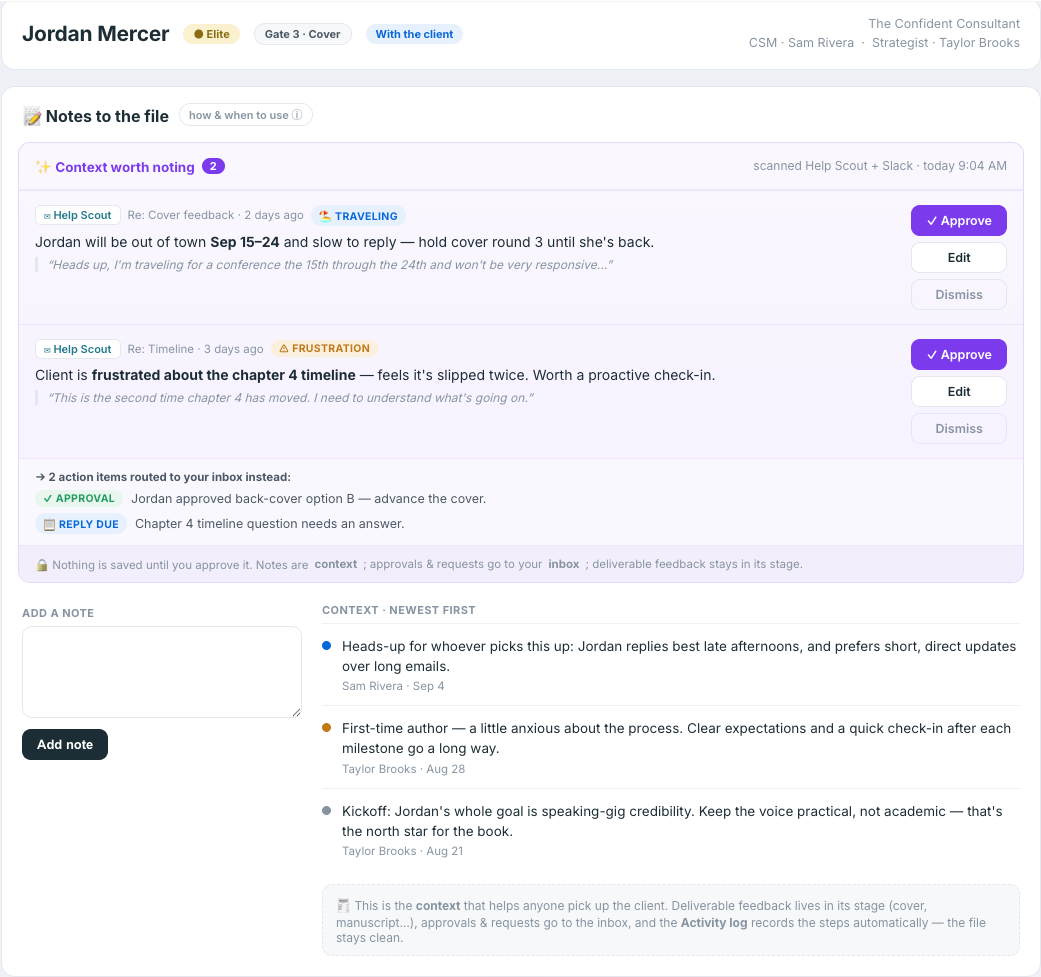
Here’s what it looks like (not a real client record).
This is a massive win for clear, consistent communication.
And, we kill system scatter at the same time.
Everything important for a project is on one screen for humans, and in one system for AI to use.
Killing Client Overwhelm Two Ways...
This is the big one. We view what we sell as ease.
One of our 3 guiding principles for the business is “We Make the Complex Look Easy.”
We invest a lot of time teaching team members what this means, and what it looks like to do it well.
And, it’s hard to do when you’re doing complicated work for clients.
I know you understand.
By building our own tool for production last year, we noticed two things...
Client leads had a much clearer signal when we were stalled waiting on client feedback...
Client leads were spending less time tool switching...
The results...
Client leads knew WHO to focus some extra TLC on, and they had time to do it.
This solves that “noisy client” problem, and keeps the quiet clients (who are usually the best clients) front and center.
BookFlow is already multiplying both impacts in our early testing.
As we add more AI support in the app in the coming weeks, here’s the payoff...
Client leads will be freed from 70-80% of the admin work they used to do.
That time will go directly into much more hands-on work with clients to eliminate roadblocks to deliver projects with even more speed, and higher quality.
Those are incredible outcomes. We’ll have even happier clients.
Everybody wins.
But how does that hit the bottom line?
This is I think the biggest takeaway for you...
The more time your team spends with clients...
Advising them.
Learning about their business.
Building relationship and trust.
Seeing other ways they are stuck.
(beyond the current engagement)
...the more opportunity they will find.
This has profound implications for who you hire.
A lot of admin work is going away. The people who can elevate to find new ways to deliver value to clients…and bring in new revenue will be prized and paid more in the Age of AI.
That’s why you should be driving AI into your business.
Yes, you. The CEO.
Your job is to innovate and find opportunity.
This is the biggest (and easiest to capture) opportunity in front of virtually every business right now.
But if AI stays a productivity parlor trick, you’ll miss it.
Steve “opportunity explorer” Gordon
Great behind the scenes look