


Results are in...
For the last nine months, I’ve experimented with AI writing this weekly newsletter.
In this issue, I’m going to breakdown what I’ve learned, what worked, what didn’t, and what I’m doing going forward.
If you’re at all interested in how AI will impact your business, I promise this will be valuable.
We launched this newsletter at the end of September of last year.
For the first month and a half, I wrote every issue the old fashioned way... fingers on keyboard.
Then, in November of last year, I started experimenting with Claude Code for help with non-programming work.
Mostly marketing ops.
And... like seemingly everyone else using AI in business, I thought, “this could make creating marketing content way faster.”
TL;DR... it did.
By December, I was starting to get the time to write a newsletter down from two hours to 30 minutes.
I’ll take 90 minutes back. WIN!
It was a game changer as I prepped to go incommunicado in Italy with my wife for two weeks.
I was able to get all the content for this newsletter and my LinkedIn feed done a couple of weeks before I left.
It was super freeing.
Even better, clients were commenting on how much they liked the content. WIN 2!
In fact, I had a client tell me that it was my emails that caused them to say “yes” to working with us. WIN 3!
Through the spring and early summer, I found the process got better. I was using AI to bat ideas around for issues. To ask me questions, to go do research for me.
I’d built a 5 stage process all orchestrated by an agent (first in Claude Code, then in Notion)...
Interview me to mine for ideas.
Push back on my assertions and find data to back them up.
Build an outline.
Write the first draft.
Rewrite based on my dictated feedback, until we got to something I was happy with.
There’s this scene in “The Crown” where Churchill is in the bathtub, sipping a scotch, and smoking a cigar... dictating his correspondence to a secretary...
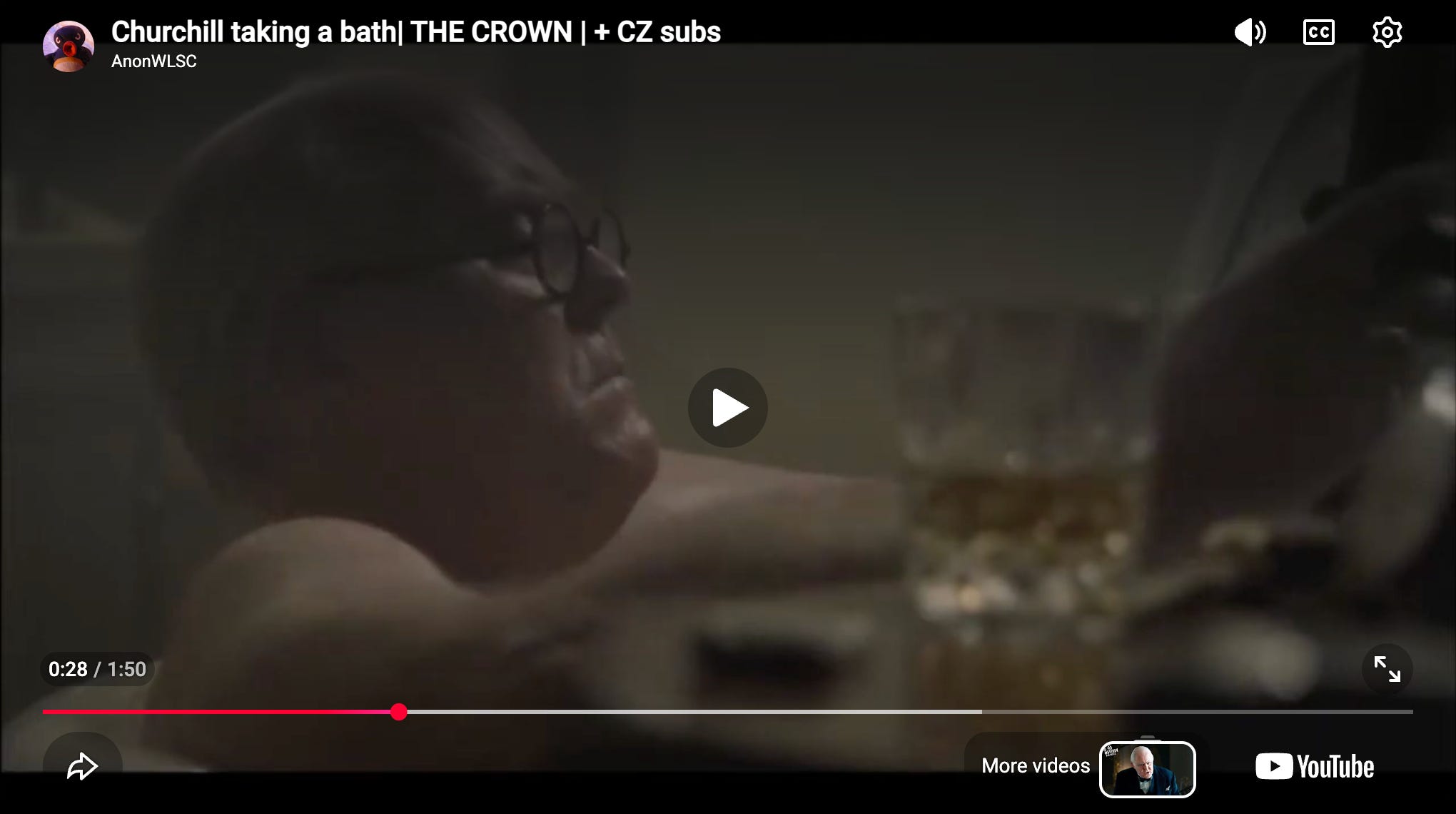
That’s what my workflow felt like. My AI assistant (I call him “Andy”...I don’t know why) would sit and dutifully make notes and changes while I sat with my feet propped on the desk (only occasionally sipping an Eagle Rare).
It was awesome.
Until it wasn’t.
I started noticing something about the newsletters we were putting out.
They were “good”.
Decently written...
But they lacked “life.”
They lacked novelty.
They became a formula, because, AI is probabilistic.
It cannot do random novelty (this is actually how the newer tool that detect AI content are able to find it).
Human on the other hand are consistently inconsistent.
We often choose a word or phrase or paragraph that would be “improbable” from the perspective of AI.
So, why am I telling you all of this?
Because I’ve gone further down the road of AI writing/content marketing than most.
Here’s what I discovered...
As the founder/CEO of a small company, the single biggest advantage I have in the marketplace is my own OPINIONATED WORLDVIEW.
There are certain things I believe to be true about the challenges our clients face, and that is my company’s secret weapon.
And AI (because it’s trained on all of published human thought) tends to pull everything back to the average.
There’s no edge.
It turns real opinions and beliefs into blunt instruments, not razors to cut the market into two groups:
Those show are attracted by what you believe.
And those who are repelled by it.
When marketing fails to create that divide, it fails.
But wait, there’s more...
The AI TRUST TRAP
There are two other important trends you need to know about...
First, AI is reaching the masses.
I’ve been traveling the country this year speaking to audiences of entrepreneurs (at this point I’ve spoken to over 1000 business owners).
And they’re all talking about how they’re using AI.
A year ago, they were all wondering how AI would impact them.
And, the #1 use case I hear (drum roll please)...
“I use it to write my LinkedIn/FB/IG posts and emails.”
I’m not saying they shouldn’t do that, no judgement.
I am saying the trend is important.
We’ve already seen a surge of poorly done AI content...and we’re about to get hit by the tsunami.
When I was 28 and had just been promoted to CEO in my first business, I was given a recording of Earl Nightingale. And I’ll never forget this line...
“If you don’t have a good model for success, just look at what everybody else is doing and do the opposite.”
Your audience is savvy. They can tell.
And, the platforms are going to help them.
Last month Substack integrated with Pangram to allow users to detect AI written content. And, wisely, they allow writers to add a “How this was created” note.
While I think it’s perfectly legitimate to use AI to create marketing content (again, I’m not a luddite, and there is no judgement here), I am seeing consumers of content ignore anything they think is AI generated.
People want real.
And that’s the opportunity that’s about to open up.
Most people will take the fast and easy route and use AI in their content marketing.
Which will open a huge opportunity for the minority of founders who leverage their #1 asset: their unique and opinionated worldview.
Does that mean we’re not using AI in the business? Absolutely not. We’re accelerating it’s use, and I’ll be sharing our experience here.
What it does mean is that if you read this, you can be confident I actually wrote it.
Not because AI can’t get close, but because I hate being pulled down to “average.”
Steve “fingers on keyboard” Gordon
P.S. We certify every book we produce for our clients with our “Written By Human” seal and have for three years. Current trends are proving that our original hypothesis is accurate >> in a world of AI and human content, people will look for ways to tell the difference. Not because they never want AI content, but because they want to know the source.
P.P.S. When you’re ready, our team is standing by to help you:
Become a Published Author — Million Dollar Author helps you extract your expertise into a book in 90 days. [Learn more →]